To: our friends who travel often to Orion and Andromeda

Maps

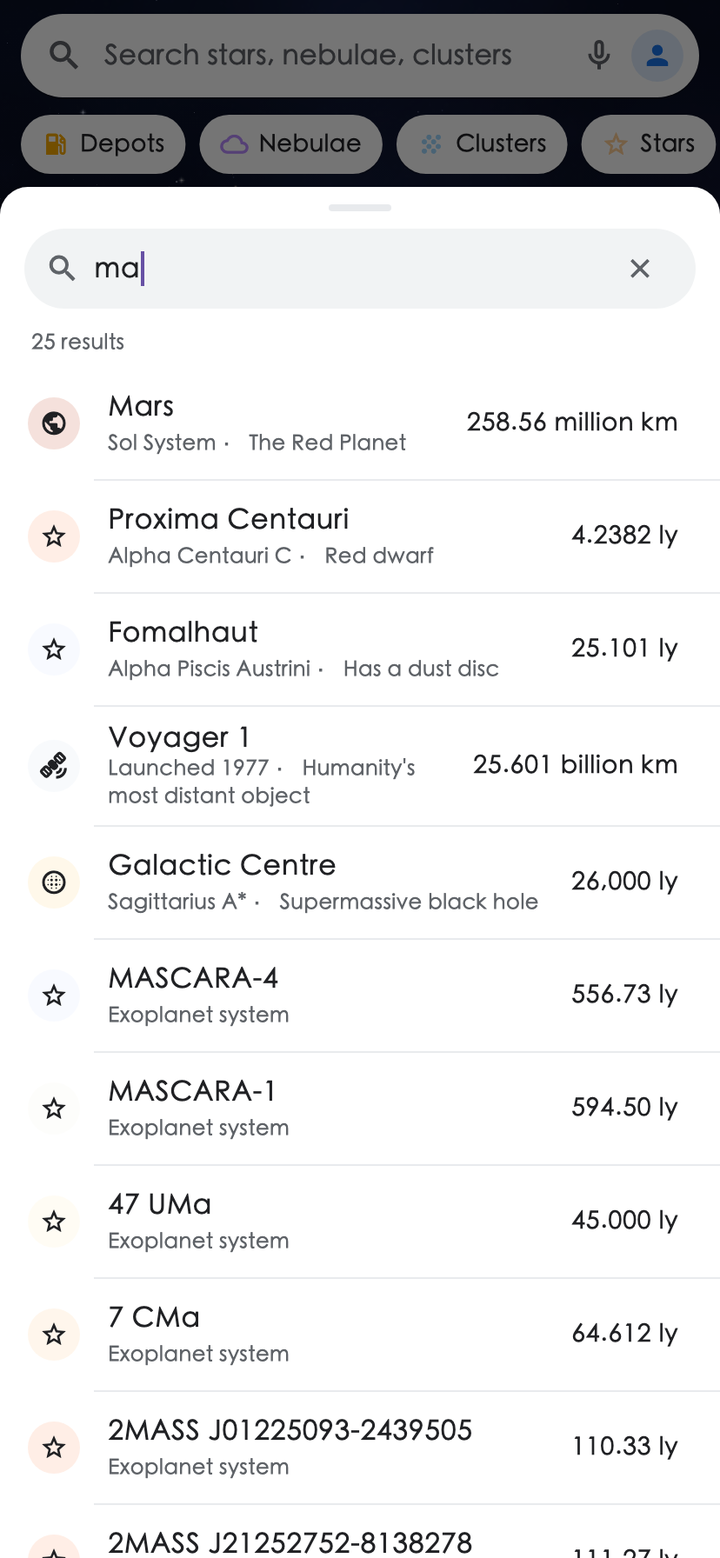
UnivMap search screen: typing “ma” lists Mars, Proxima Centauri, Voyager 1 and the Galactic Centre with the distance to each
11,098places
6ways to travel
12orders of magnitude of zoom
0network requests

Features

Works like the map you already use

Search, plan, leave, arrive. Nothing about the flow is unusual — there are simply more destinations to choose from.

Place search

Suggestions appear as you type. Names are matched in both languages, along with common aliases and catalogue designations. Results are sorted by distance from you.

Directions

Each way to travel is planned separately, and the fastest is labelled. Most destinations offer two or three options, including "leave now" and "wait for it to come to you".

Arrival times

Shows the date you'll arrive. Where that falls outside the range a calendar can express, it reads "910 million years from now" instead. Time remaining updates as you travel.

Your location

A blue dot. Currently on Earth. The button in the bottom right recentres on the solar system. Panning the map unlocks it, as usual.

Live traffic

Green is clear, amber is busy, red is congested. Advisories appear before you set off — for example, "Meteoroid stream control 300 million km ahead; change lanes early."

Offline

The catalogue is baked into the app. No network requests at runtime, no account required. Useful around Alpha Centauri, where there is currently no coverage.

Ways to travel

Six of them, all costed

Switching changes the route itself, not just the number — the same way asking for walking directions and driving directions gives you two different paths.

Way to travel Cruising speed To Alpha Centauri
4.37 light years
CO₂ to Mars
one way
🚀 InterstellarLight speed4 yr1.37 million t
🛰️ Crewed rocket60,840 km/h89.9 million yr2,883 t
🚗 Driving110 km/h36.6 billion yr9,637 t
🚌 Bus60 km/h36.8 billion yr2,118 t
🚲 Cycling20 km/h91.6 billion yr396 t
🚶 Walking5 km/h349 billion yr651 t

Cycling has the lowest emissions. Walking is slightly higher, because you are breathing and food has a carbon footprint. Speeds are given relative to the solar system — shared motion is already subtracted, so nothing needs adding when you leave.
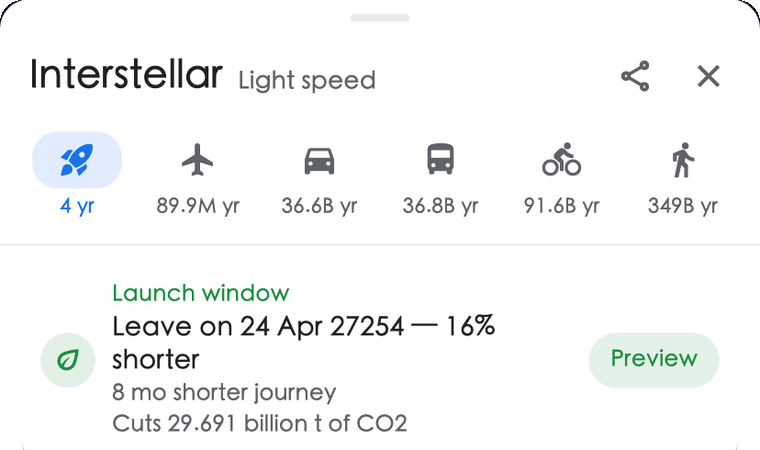
UnivMap showing six ways to travel to Alpha Centauri with times from 4 years to 349 billion years
Every way to travel is planned and timed separately.
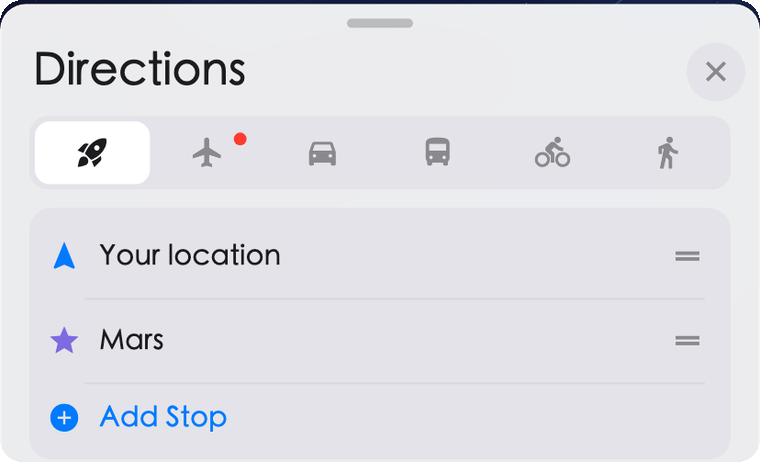
UnivMap directions sheet showing a route from Your location to Mars
Set an origin and a destination, then add stops.

Departure suggestions

Avoid rush hour,
or an entire century

Just as an ordinary map suggests leaving ten minutes later to miss the traffic, UnivMap scans a full synodic period to find the best day to set off. The planets keep moving, so leaving a day earlier or later can matter quite a lot.

Of the 780-day cycle to Mars, the crewed rocket can only fly on about 30 days — which is also why real Mars missions launch once every 26 months.

🍃
Launch window
Leave in 384 days — 74% shorter
5,424 years off the journey
Preview
Shortest journey
Leave in 153 days — arrive 2,330 years sooner
2,573 years → 244 years
Preview
UnivMap launch window card suggesting a departure on 6 July 2001, 74% shorter

The suggestion is calculated per way of travelling, so the best day is usually different for each. "Preview" moves the timeline to that date so you can see how the planets will be arranged.

Route details · Bus · to Uranus
  • Earth · Depart
  • Mars · Gravity assist · Stop
  • Uranus · Arrive
1 stop · 665 years 6,116 years direct

Transit

The bus stops along the way

Like any bus, it isn't direct — it calls at stops en route. The difference is that every stop is also a gravity assist, so inside the solar system stopping is considerably faster than going direct.

How many stops depends on what happens to be on the way. To Alpha Centauri there are only two, the origin and the destination, because there is nothing in between to call at. Full timetable is in the route card.

This service accelerates using planetary gravity and gets faster at every stop. Please be patient during the first few hundred years.

Traffic

Check before you go

Conditions are colour-coded along the route, as on any map. Advisories cover restrictions on the way.

Clear
Busy
Congested
Meteoroid stream control 300 million km ahead; change lanes early
Interstellar pirates and high radiation zones avoided. Cuts 8 months

Honest estimates

If you can't get there,
it says so

Some destinations are moving away, faster than you can travel. The estimate then reads ∞ yr and the launch button is greyed out. The distance is still shown — the route is perfectly real, you just won't finish it.

Voyager 1 travels at 60,906 km/h. The crewed rocket travels at 60,840 km/h. The difference is 66 km/h.

🚗 Driving · 110 km/h relative to the Sol System
∞ yr 25.818 billion km
● It outruns you
⊘ Can't catch up

Directions from Earth to Voyager 1.

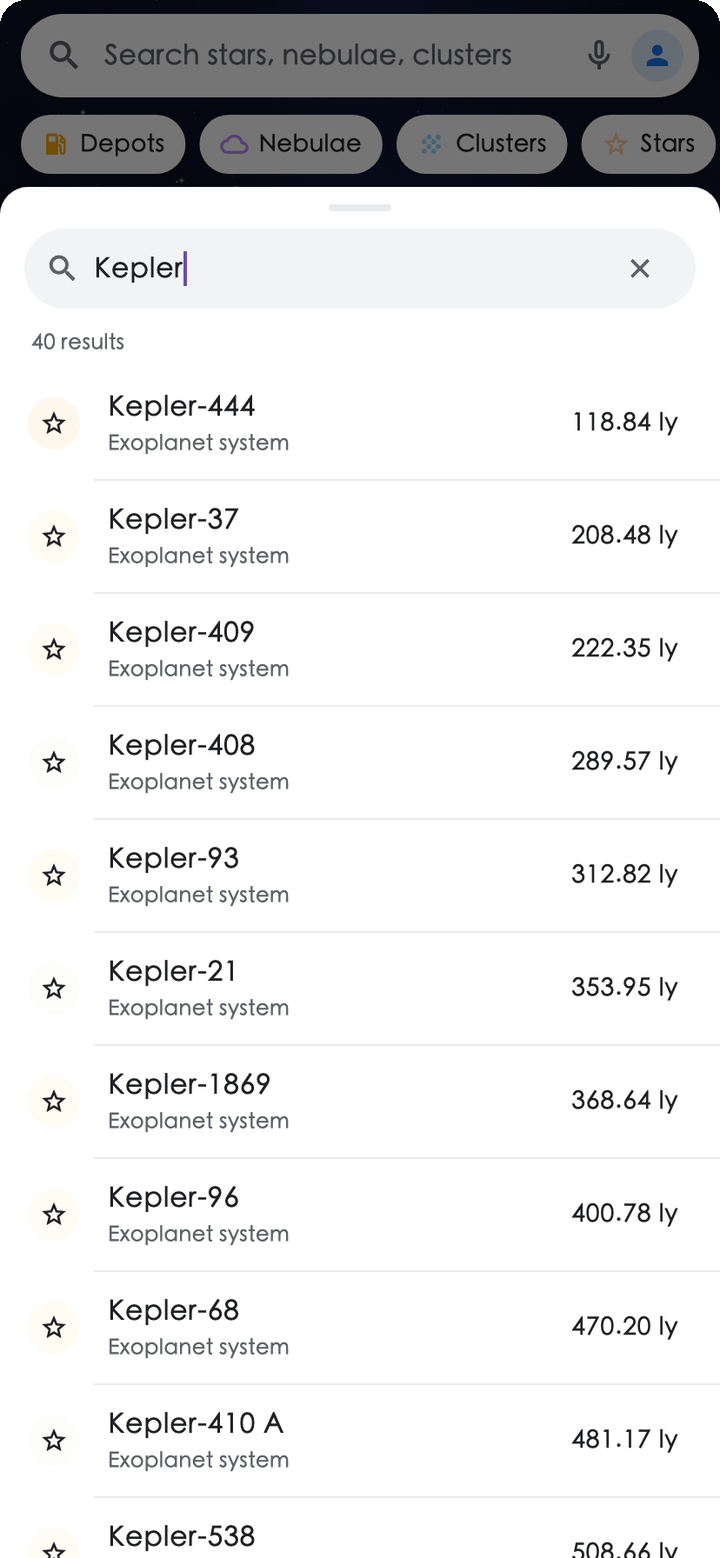
UnivMap search results for “Kepler”: NASA catalogue exoplanet systems listed alongside curated places, each with its distance

Coverage

Over 11,000 places

Planets and moons of the solar system, nearby stars, clusters and nebulae, and five probes still in flight.

Exoplanet systems4,731
Exoplanets6,320
Stars, clusters and nebulae42
Planets and moons12
Space probes5

The map zooms across twelve orders of magnitude — from the whole galaxy down to the Moon's orbit around Earth. Planets orbit at their real periods, stars drift at their measured proper motions, and the timeline can be moved forwards or backwards.

Data

Places come from public astronomical databases

Exoplanets from the NASA Exoplanet Archive, probe state vectors from JPL Horizons, and stellar proper motions and radial velocities from SIMBAD. Planet positions are computed from J2000 orbital elements.

NASA Exoplanet Archive JPL Horizons SIMBAD J2000 epoch

FAQ

Things you might want to know first

How long does it take to drive to Alpha Centauri?

About 36.6 billion years at 110 km/h, over a distance of 4.37 light years. Check traffic before you leave and allow time for rest stops.

How long does it take to walk to Mars?

About 7,212 years. If you take the suggested departure date and leave 384 days from now, the journey is 5,424 years shorter.

What is the fastest way to get to the Moon?

The crewed rocket, at 3.0 days of flight time — matching the 73 hours 5 minutes Apollo 11 actually coasted.

The Moon has no launch window, so you can leave on any day. Earth carries the Moon along with it, so moving your departure date doesn't change where they are relative to each other. Mars is different; it has an orbit of its own.

Why is the bus slower than driving?

The bus stops along the way. To Alpha Centauri it takes 36.8 billion years versus 36.6 billion by car.

Inside the solar system the stops make it faster instead: the bus to Uranus stops once at Mars and takes 665 years instead of 6,116, because every stop is also a gravity assist.

Why can't I catch up with Voyager 1?

It travels at 60,906 km/h. The crewed rocket travels at 60,840 km/h. The difference is 66 km/h.

The estimate for that route reads "∞ yr", labelled "It outruns you". The distance is still shown: 25.818 billion km.

Does UnivMap need an internet connection?

No. The star catalogue is baked into the app, there are no network requests at runtime, and no account is required. There is no coverage around Alpha Centauri.

What languages does UnivMap support?

English and Traditional Chinese. Place names are available in both, and search matches aliases as well as catalogue designations — typing Tau Ceti, 天倉五 or HD 10700 all find the same star.

How are the emissions calculated?

From real emission factors multiplied by distance — driving is 0.12 kg per km. The crewed rocket follows Δv instead: one Saturn V-class launch is about 3,000 tonnes. Leaving is what's expensive, not the distance.

Nothing is zero. Walking is 0.0083 kg per km, because you are breathing and food has a carbon footprint.
Can I use UnivMap to point a telescope?

Not recommended. Orbits are treated as circular and perturbations are not modelled. Which side of something you are on, and what is nearer to what, is correct — but don't use it for observation planning.

Ready to set off?

Check the launch window first. The next departure for Mars is in 454 days.

Coming to the App Store Coming to Google Play ›